≈ 3 min read
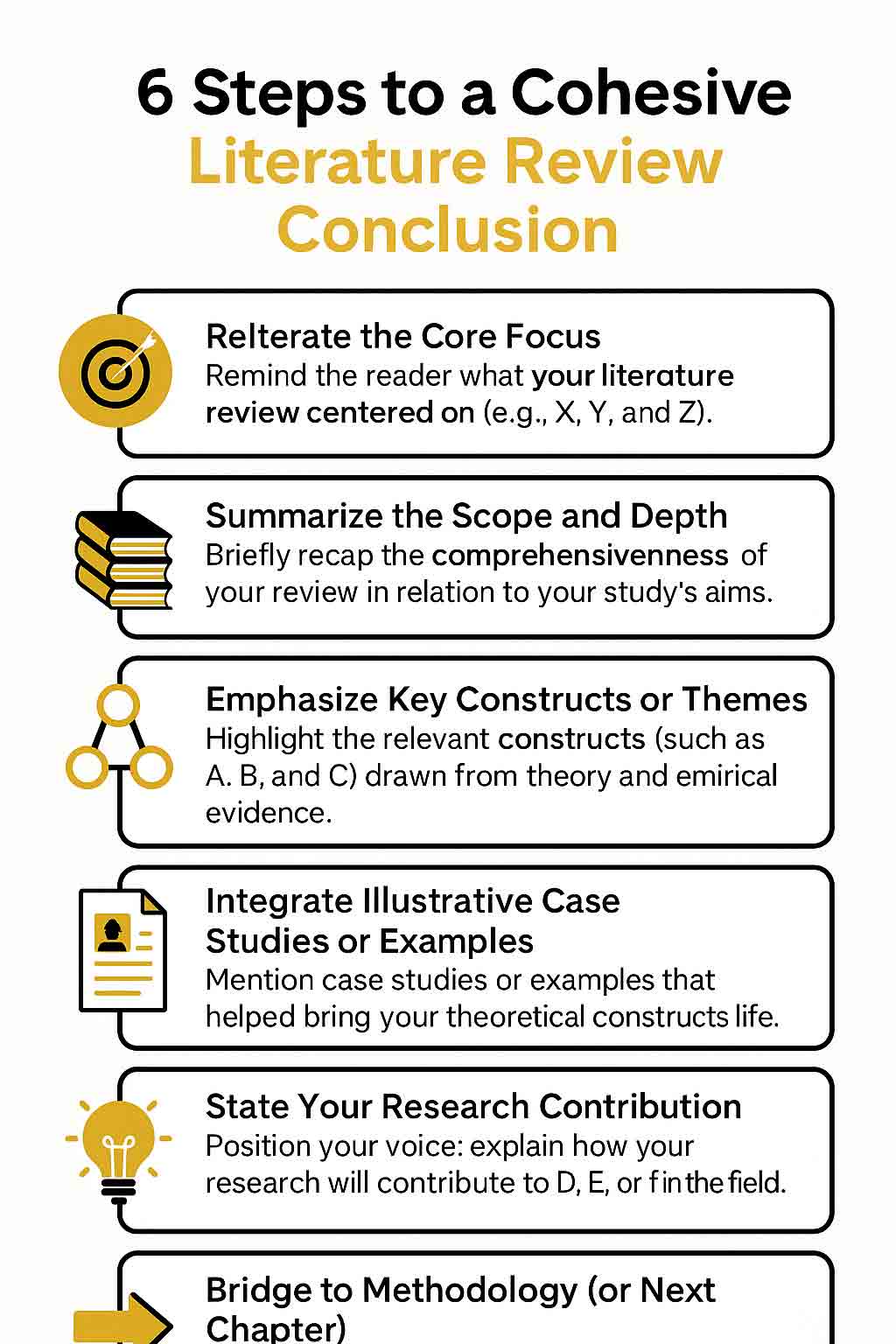
Here’s how you can structure your conclusion to accomplish those goals (you can adapt the order as suits your discipline or writing style):
- Reiterate the Core Focus
Remind the reader what your literature review centred on (e.g., themes X, Y, and Z). This anchors your conclusion in the same conceptual territory you traversed earlier. - Summarise the Scope and Depth
Briefly recap how comprehensive your review was—how you covered theoretical foundations, empirical studies, and debates—and show how that maps onto your study’s aims. - Emphasise Key Constructs or Themes
Pull out the most relevant constructs (like A, B, C) that you’ll carry forward. Show how your judgment led to highlighting them, drawing on both theory and empirical evidence. - Integrate Illustrative Case Studies or Examples
If your chapter included case studies or exemplars, mention them here as anchors that solidify your theoretical arguments. - State Your Research Contribution
Make clear what you bring to the table. Position your voice: how will your work contribute to D, E, or F in the field? This helps the reader see your trajectory. - Bridge to Methodology (or Next Chapter)
End by explaining how the insights from the literature review inform your research design, methods, or next chapter. This signals that the story continues—and gives readers a sense of direction.
How This Supports Flow & Coherence
Without a conclusion (or one done poorly), your literature review risks becoming a disconnected survey. Your reader is left hanging, wondering how all these studies connect to your work. The conclusion helps knit these threads back to your central research narrative and gives you momentum to move into your methodology or data chapters. It also sets expectations: “Here’s what I learned, this is why it matters, and here’s where I’m going next.”
Practical Tips for Writing It Well
- Write it after you finish the chapter. As your review evolves, your key takeaways might shift.
- Keep it concise. You don’t need to mirror the intro or rehash everything.
- Mirror language. Echo keywords or structure from your introduction to create a subtle harmony.
- Avoid redundancy. The conclusion should reflect, not simply repeat.
- Use transitional language. Phrases like “this leads into,” “building on,” “the next chapter examines,” etc., help the reader move forward naturally.

Yeah, I always forget that without a proper conclusion, everything just kind of floats there—the bit about “knitting threads back to your central narrative” really clicks because that’s exactly what it feels like when you’re reading a lit review that doesn’t land anywhere.